Gradelu › Guides › Does a W affect your GPA?
Does a W affect your GPA?
No, not at the universities checked here: Rutgers, Stanford, the University of Illinois and Clayton State all leave a W out of the GPA. What can count is a late withdrawal recorded as WF, which Clayton State calculates just like an F. In the semester below, a W leaves a 3.45 at 3.45; the same course as an F or WF drops it to 2.84.
Grade codes and the GPA, from the registrars
| Code | In the GPA? | What the source says |
|---|---|---|
| Dropped before the deadline | No, and no record | Stanford: a course dropped before the week-3 deadline disappears from the transcript. |
| W (withdrawal) | No | Rutgers SAS: a W is not a grade and is not part of the term or cumulative GPA. Stanford: no GPA impact. Illinois: W, authorized withdrawal, is marked not included in GPA. Clayton State: not included. |
| WF (withdrew failing) | Yes, as an F | Clayton State: a withdrawal after the published deadline gets a WF unless a hardship exception is granted, and a WF counts in the GPA just like an F. |
| Stopped attending, no withdrawal filed | Yes, as an F | Clayton State: a student who stops coming without an official withdrawal is assigned an F. |
| CR / pass | No | Illinois: CR (credit earned) is not included in GPA; since Fall 2022 it needs a D- or better. |
| NC / no credit | No | Illinois: not included; since Fall 2022 an F in a credit/no credit course converts to NC. |
| I (incomplete) | No, while it is an I | Illinois: approved extension of time; not included in GPA. |
| AU (audit) | No | Illinois: attendance as a visitor only; not included. |
| ABS (absent from final) | Yes, as a failure (before Fall 2025) | Illinois: counted as a failure for terms prior to Fall 2025; in credit/no credit courses from Fall 2022 to Summer 2025 it converted to NC instead. |
Rules are set by each school and can change by catalog year, as the dated Illinois entries show.
The same semester with a W, a D and an F
Start from four graded courses: B+ in a 4-credit course, A- (3 credits), B (4) and A (3), on a plus/minus scale with A- = 3.7. That is 48.3 quality points ÷ 14 credits = 3.45. Now add a fifth course, 3-credit Statistics, and vary only its outcome:
| Statistics ends as | Arithmetic | Semester GPA | Change |
|---|---|---|---|
| W (or pass, or drop) | 48.3 ÷ 14 | 3.45 | 0 |
| C (2.0) | (48.3 + 6) ÷ 17 | 3.19 | −0.26 |
| D (1.0) | (48.3 + 3) ÷ 17 | 3.02 | −0.43 |
| F or WF (0) | (48.3 + 0) ÷ 17 | 2.84 | −0.61 |
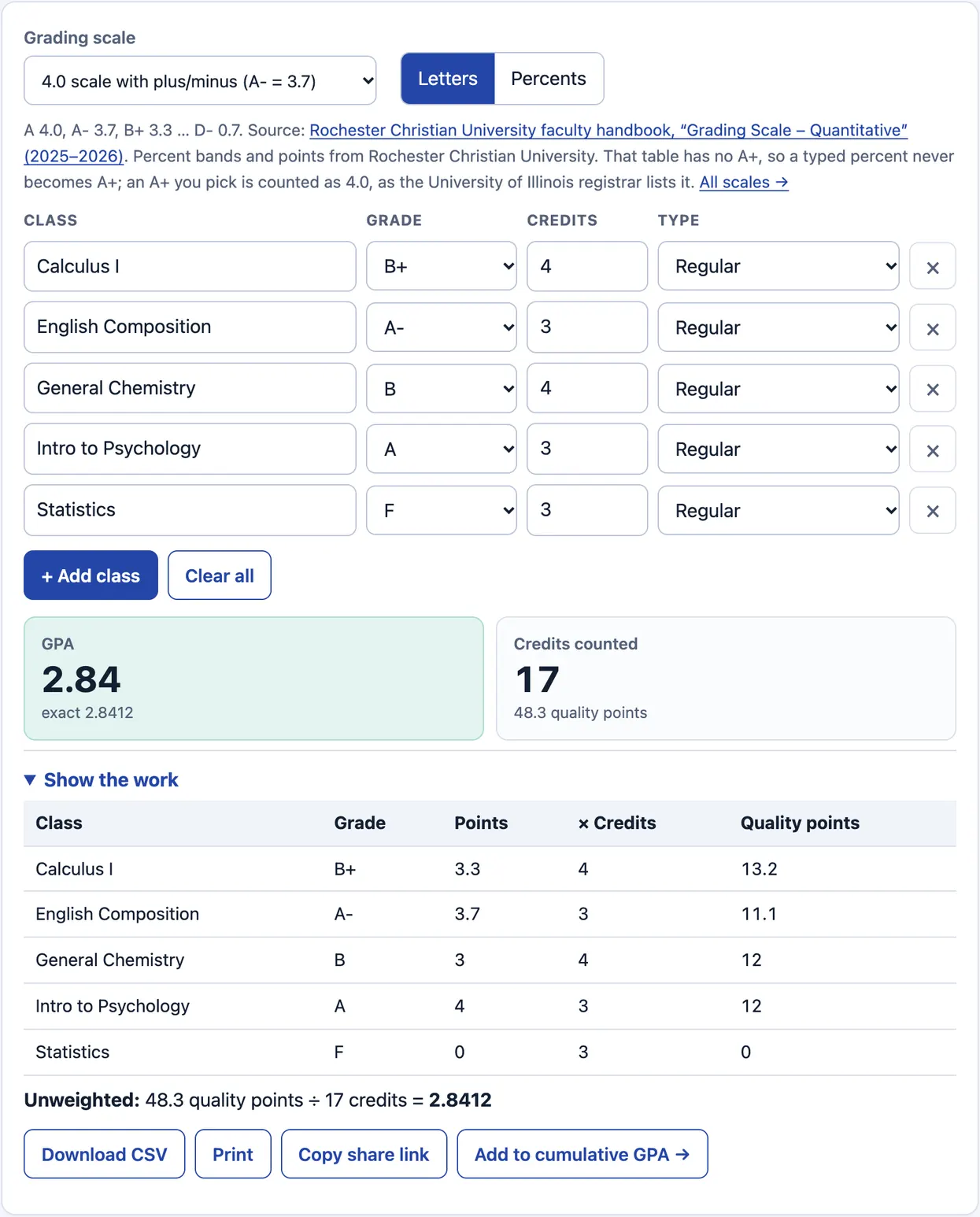
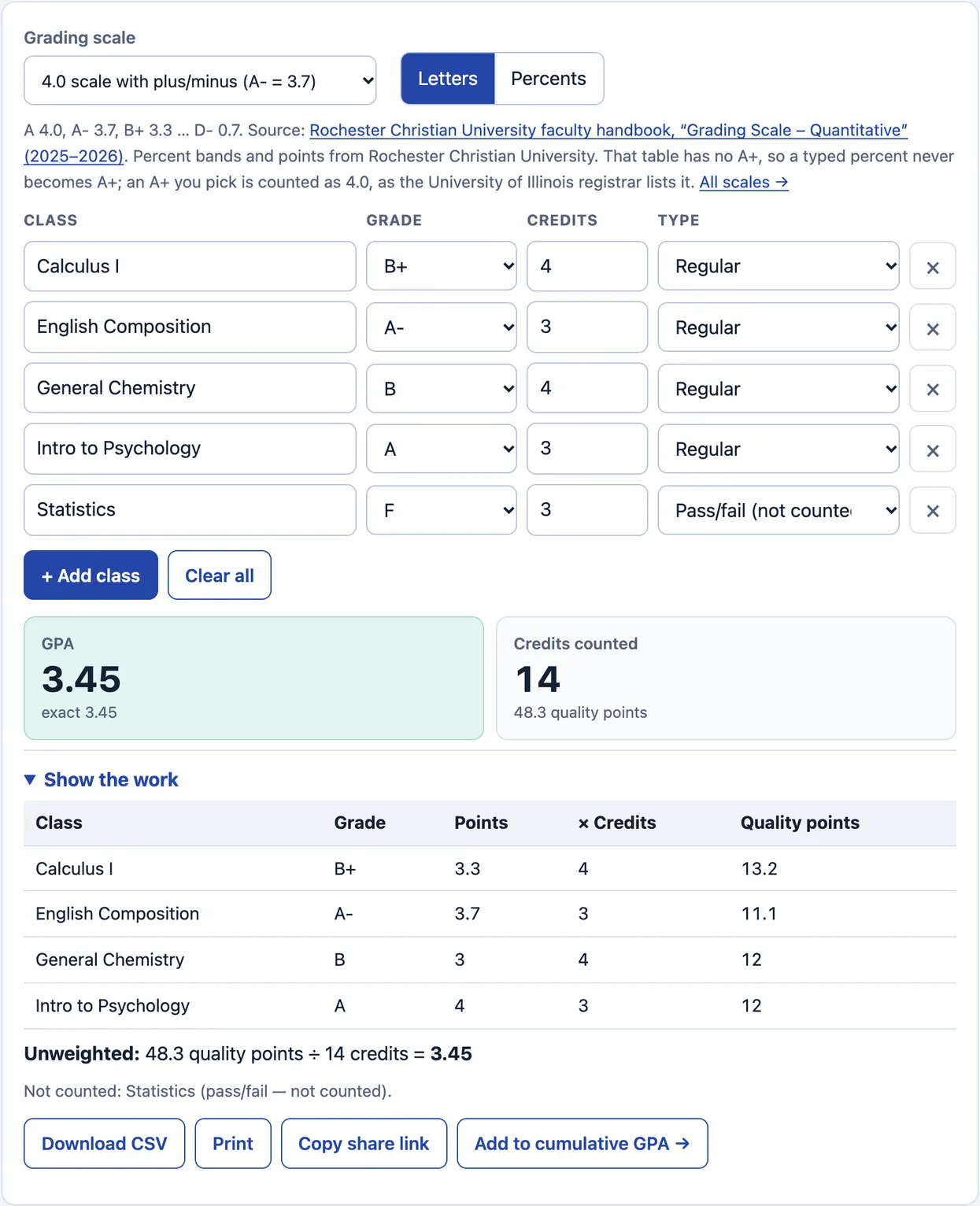
The pass/fail decision works the same way. A counted grade lowers your GPA whenever its points are below your current GPA: here any grade under 3.45, so even a B+ (3.3) would pull it down slightly. A pass leaves it alone, but at Illinois a failing grade under credit/no credit becomes NC rather than an F.
What a W can still cost
- Financial aid. Rutgers says repeated Ws can cost future aid because they lower the share of attempted credits you complete; Clayton State also says a W may affect aid eligibility.
- Full-time status. Stanford advises talking to an advisor before a withdrawal takes you below 12 units.
- Retakes. At Stanford a W cannot be overwritten on your transcript by repeating the course, and a withdrawn class does not count toward the repeat limit. How retakes change a GPA is in how much can you raise your GPA in one semester.
- Patterns. Stanford’s handbook says an occasional W is common and that readers notice Ws mainly when they form a recurring pattern.
Check your own semester
Enter your courses in the college GPA calculator, add the course you are thinking of dropping with the grade you expect, then switch it to Pass/fail (not counted) and compare the two GPAs. Carry the result into the cumulative GPA calculator to see the effect on your overall GPA, which is smaller the more credits you already have. If you track grades in a spreadsheet, the Excel guide shows how to keep W and pass/fail rows out of the formula.
Sources
Next step
Sources opened 11 November 2026. All guides · How the scales were chosen.