Gradelu › Guides › How much can you raise your GPA in one semester?
How much can you raise your GPA in one semester?
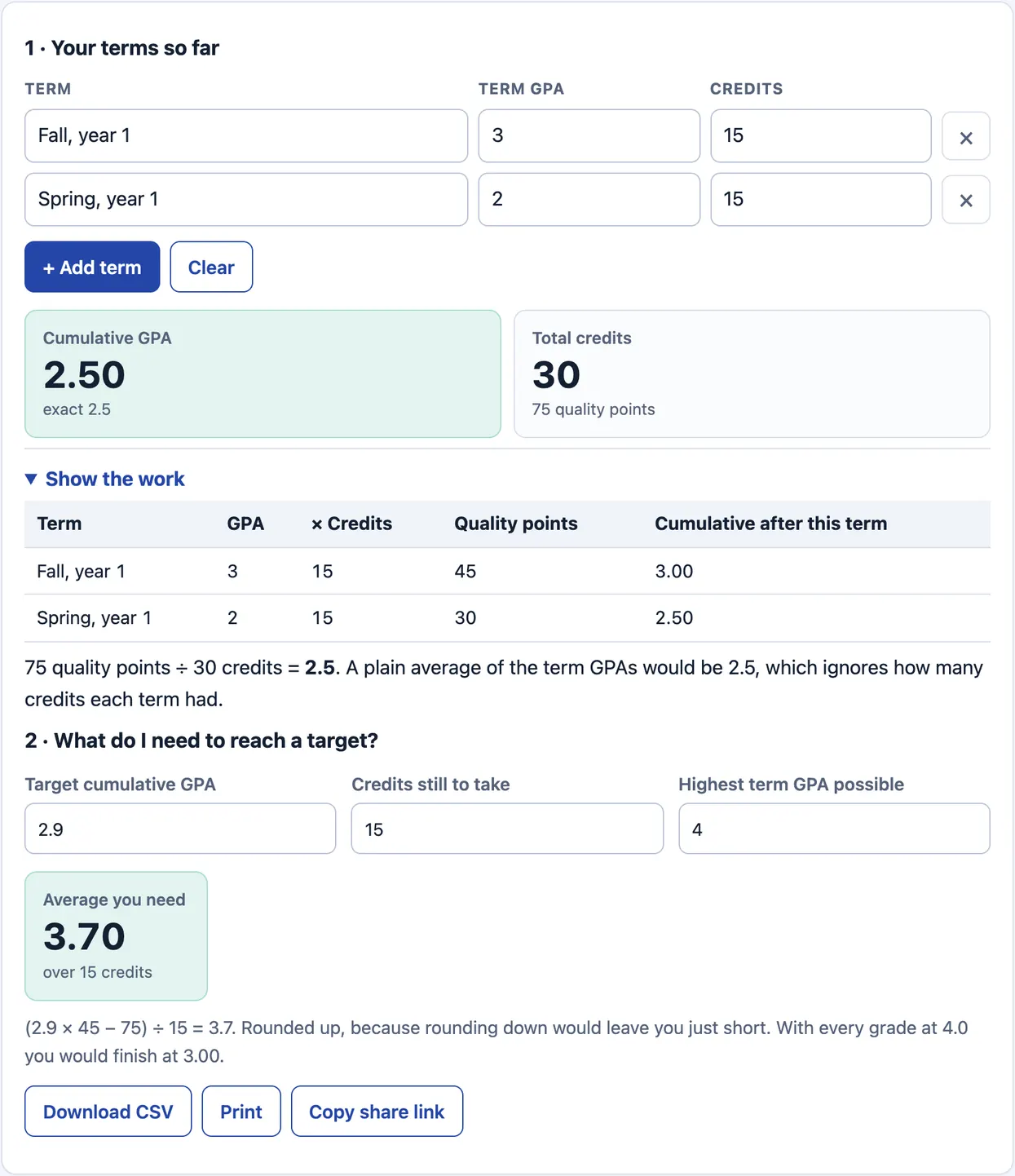
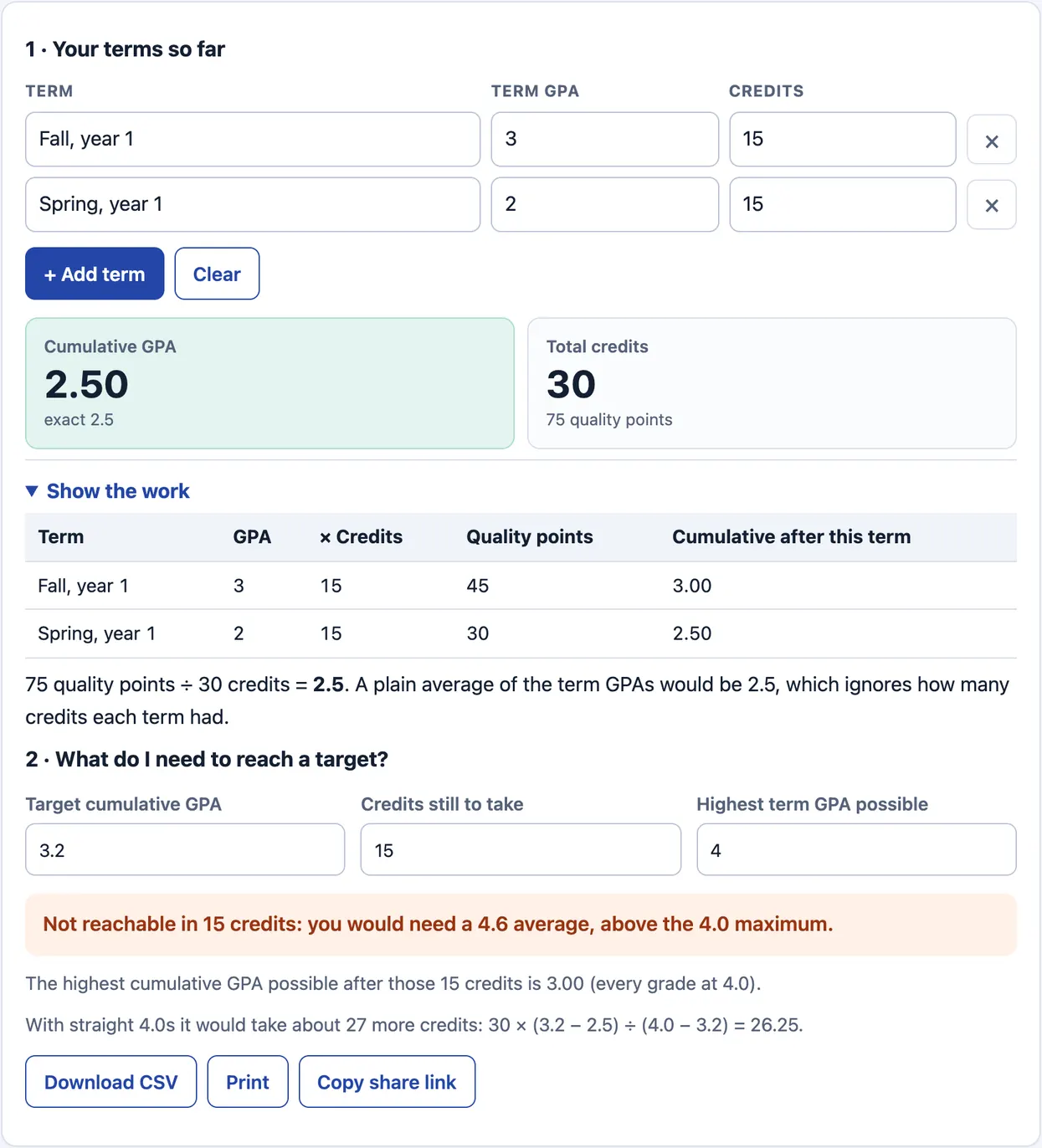
You can raise it by at most (4.0 − current GPA) × new credits ÷ (credits so far + new credits). With 30 credits and a 2.50, a perfect 15-credit semester reaches 3.00. With 90 credits and the same 2.50, the same perfect semester reaches only 2.71. The earlier you act, the more one semester can do.
The formula
New GPA = (current GPA × credits so far + term GPA × term credits) ÷ (credits so far + term credits)
It is the cumulative GPA method Mount Holyoke’s registrar describes: add the quality points from every term and divide by the total graded credits. Subtract the current GPA and the rise is (term GPA − current GPA) × term credits ÷ total credits. The best case is a term GPA of 4.0.
The ceiling: one 15-credit semester of straight A’s
| Credits already taken | From 2.50 | From 3.00 | From 3.50 |
|---|---|---|---|
| 15 | 3.25 (+0.75) | 3.50 (+0.50) | 3.75 (+0.25) |
| 30 | 3.00 (+0.50) | 3.33 (+0.33) | 3.67 (+0.17) |
| 60 | 2.80 (+0.30) | 3.20 (+0.20) | 3.60 (+0.10) |
| 90 | 2.71 (+0.21) | 3.14 (+0.14) | 3.57 (+0.07) |
Each cell is current GPA + (4.0 − current GPA) × 15 ÷ (credits + 15). The same perfect semester is worth less than half as much after 60 credits as after 15: from 2.50 it adds 0.30 instead of 0.75 (×15/75 instead of ×15/30). And the lower your GPA, the more room a 4.0 has to pull it up: from 2.50 there is 1.5 points of gap, from 3.50 only 0.5.
A semester that is good but not perfect moves far less. A 3.5 term over 15 credits, starting from 3.00 with 60 credits behind you: 3.00 + 0.5 × 15 ÷ 75 = 3.10. A 3-credit summer course at 4.0 from 2.50 with 60 credits: 2.50 + 1.5 × 3 ÷ 63 = 2.57.
Worked example: what you need, and when it is out of reach
A first-year student finished fall with a 3.0 over 15 credits and spring with a 2.0 over 15 credits: (45 + 30) ÷ 30 = 2.50. The next semester is 15 credits.
Two common questions, answered with the same formula
- Can I raise a 2.5 to a 3.0 in one semester? At 4.0, the credits needed are credits so far × (3.0 − 2.5) ÷ (4.0 − 3.0) = half your credits so far. With 30 credits, 15 credits of A’s gets you exactly there; with 60 credits, it takes 30.
- Can I go from 2.0 to 3.0 in a year? Credits needed at 4.0 = credits so far × 1.0 ÷ 1.0, the same number of credits you have already taken. After one 30-credit year, a perfect 30-credit year does it; after two years, it would take two perfect years.
Retaking a class: one course that can move as much as a semester
A retake can take a bad grade’s credits out of the GPA instead of only adding new ones, but only under a replacement policy, and policies differ. Three published ones:
- Rensselaer (RPI): undergraduates may repeat a course up to two times, and the most recent grade is used to compute the GPA.
- CU Boulder: for undergraduates whose last attempt was a C- or lower in a CU Boulder course, replacement is applied automatically if the new grade is the same or better; if it is lower, both attempts count. You can opt out, and then all attempts count.
- University of Arizona: for undergraduate repeats from Fall 2025, the highest graded attempt is used, automatically for regular courses with an original grade of C, D or E.
Example: 30 credits and a 2.80 GPA, which is 84 quality points, including a 4-credit Calculus F. The retake earns a B (3.0 × 4 = 12 quality points).
| Policy | Arithmetic | New GPA |
|---|---|---|
| Both attempts count (no replacement) | (84 + 12) ÷ 34 | 2.82 |
| Replaced (RPI, CU Boulder and Arizona all replace here) | (84 − 0 + 12) ÷ 30 | 3.20 |
The same B is worth +0.02 or +0.40. Replaced, it does as much as a full 15-credit semester of straight A’s would: (84 + 60) ÷ 45 = 3.20. When the retake goes worse, the three policies split. Say the first attempt was a D (4 quality points of the 84) and the retake is an F:
| Policy | What counts | New GPA |
|---|---|---|
| RPI: most recent grade | The F: (84 − 4 + 0) ÷ 30 | 2.67 |
| CU Boulder: lower grade, so no replacement | Both: (84 + 0) ÷ 34 | 2.47 |
| Arizona: highest attempt | The D: 84 ÷ 30 | 2.80 |
Both examples meet the conditions above: Arizona’s failing grade is E, so its “C, D or E” covers the F, and an F and a D are both C- or lower at CU Boulder. Withdrawals are a separate case: at Stanford a W cannot be overwritten on your transcript by repeating the course (see does a W affect your GPA).
Plan it with your numbers
Enter your finished terms in the cumulative GPA calculator, then a target and the credits you have left. To model a replacement retake, take the old course out of its term first: work that term’s GPA again in the college GPA calculator without the course, then add the new attempt to the term you retake it in.
Sources
- Rensselaer Polytechnic Institute Registrar, “Repeating a Course”
- University of Colorado Boulder Registrar, “Retake a Course for Grade Replacement”
- University of Arizona, “Repeating a Course & Grading for Repeated Courses” (UA@Work announcement)
- Mount Holyoke College Registrar, “How to Calculate Your GPA”
Next step
Sources opened 11 November 2026. All guides · How the scales were chosen.